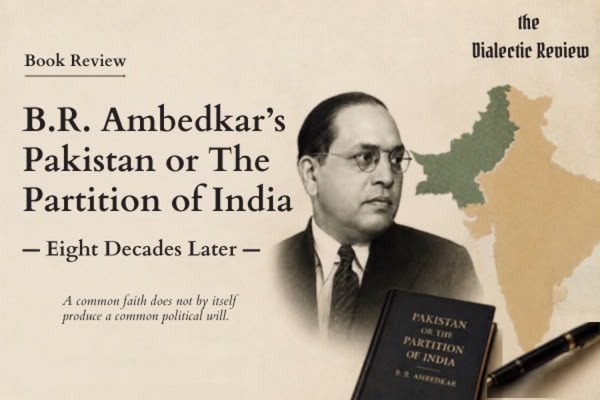
B.R. Ambedkar’s Pakistan or The Partition of India was published in 1945, expanding on his earlier 1940 work, Thoughts on Pakistan. It predates the country it’s named after by two years, written when Pakistan existed only as a proposal and an argument. It reads less like history than a legal brief filed before the verdict, one that somehow still applies to the world the verdict created.
Ambedkar is remembered in most of the subcontinent for one thing: chief architect of India’s constitution, and the most consequential Dalit leader of the twentieth century.
Born into a family considered “untouchable” under the Hindu caste system, he grew up facing discrimination that denied him even a seat in the classroom, he became one of the most formally educated men of his generation, with degrees from Columbia and the London School of Economics, and spent his life turning that education into a weapon against the system that tried to keep him out.
By the time he sat down to write on Pakistan, he had no institutional loyalty to protect. Not a Muslim League man, not a Congress loyalist. That is what makes the book worth trusting even when you disagree with it.
He took the Lahore Resolution’s language about Muslim-majority zones and mapped it onto real provinces: Punjab, Sindh, the North-West Frontier, and Baluchistan in the west, Bengal in the east. But he didn’t stop at accepting the boundaries the League implied. He went province by province and asked where Hindus and Muslims actually lived, and the answer split the map in two. In Sindh, Baluchistan, and the Frontier, the communities were too intermixed to separate territorially, so minorities there would only ever get cultural safeguards. Punjab and Bengal were different.
Muslims held a bare majority in both, just over half in each case, but Hindus and Sikhs sat in solid, contiguous blocks rather than scattered pockets. That distinction is what led him to argue Punjab and Bengal themselves would need to be split, not just carved out whole. He wrote that two years before it happened almost exactly that way.
That question outlived the country that was supposed to answer it. Buried earlier in the book, in his chapter weighing whether Muslims even constituted one nation, Ambedkar recorded a fact that would matter more than he could have known: Punjab’s Hindus and Muslims both spoke Punjabi, Bengal’s Hindus and Muslims both spoke Bengali, and only in the towns did Muslims speak Urdu at all.
He cited it to counter the claim that Muslims were one exclusive linguistic nation apart from Hindus. But the same fact cuts the other way too — Bengal’s Muslims and Punjab’s Muslims never shared a language of their own either, only religion, which is exactly the seam the Bengali language movement reopened a decade later, and the one that finally split the country in 1971.
He had written that a common faith does not by itself produce a common political will, and warned a country built mainly on distinguishing itself from Hindus would eventually have to figure out what it was for, not just what it was against. Pakistan is still having that argument with itself, in different vocabulary, in every election and every debate about provincial autonomy.
Where he missed badly is the population transfer. He treated it as a solvable administrative problem, working through customs duties and pension transfers like a man drafting a treaty, on the assumption that if Punjab and Bengal were properly redrawn, mass migration wouldn’t be needed at scale. He underestimated the scale of the population transfer, whose violence and upheaval ultimately cost millions of lives.
The minorities who remained anyway, on both sides of the eventual line, were left exactly as exposed as he separately warned they might be, dependent on the goodwill of majorities that had just spent years being told coexistence was impossible.
What makes the book worth reading now isn’t that Ambedkar got the outcome right. What holds up is his refusal to let sentiment do the work of argument, at a moment when even saying partition might be necessary was treated as betrayal.
The book is also very much a document of its moment, and worth reading critically rather than reverently. Ambedkar’s own political position, his relationship to Congress and to Gandhi in particular, colors the analysis throughout, and readers should notice where that shapes his conclusions.
Eighty years on, Punjab and Bengal are still cut exactly where he said the map would have to give. That is why Pakistan or The Partition of India remains a book worth reading, not as prophecy fulfilled, but as an argument that still demands an answer.