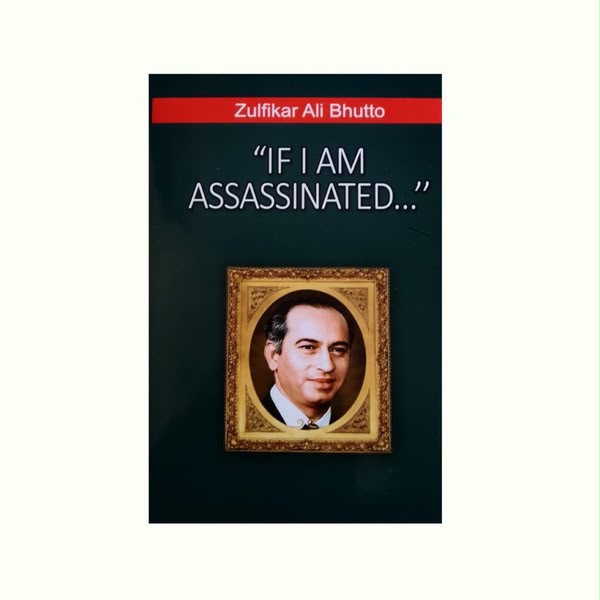
A day in the District Jail, Rawalpindi. A prisoner, appellant in Criminal Appeal No. 11 of 1978 before the Supreme Court of Pakistan, sits in a death cell for twenty-two hours a day, paper resting on his knees, writing a rejoinder that will have to be smuggled out if it is to survive him. The prisoner is no ordinary man. He is Zulfikar Ali Bhutto, the ousted Prime Minister of Pakistan, and the document he is writing is If I Am Assassinated.
It began, in fact, as a legal submission. During the pendency of his appeal, the Zia-ul-Haq regime issued two White Papers, one on alleged rigging in the March 1977 elections and another on the alleged misuse of the news media during Bhutto’s government.
Bhutto’s response, written while his appeal against his murder conviction was before the Supreme Court, was published in book form in 1979. It is not quite a memoir and not quite a legal brief but something rarer: a condemned man’s closing argument, addressed simultaneously to the Court and to history.
The book opens with the Supreme Court petition itself, and that choice of framing tells you how Bhutto wants to be read. His central grievance, returned to with the persistence of a man who has nothing left but argument, is that his defence was being conducted under circumstances in which the state’s allegations received a far wider public platform than his own response.
He points to the publication of the White Papers while his appeal was pending and argues that the Zia-ul-Haq regime could publicise its case while he remained confined in a death cell without access to the material needed to answer it. “More than my life is at stake,” Bhutto writes. The sentence captures the book’s governing idea: for Bhutto, the case was not merely about his guilt or innocence, but about whether the machinery of law could be turned against a former head of government while controlling the conditions under which his defence could be heard.
From there, the book proceeds through the allegations surrounding the 1977 elections and the conduct of Bhutto’s government. Its chapters address alleged electoral rigging, the Election Commission, the “Larkana Plan”, government machinery, the “Foreign Hand” and finally Bhutto’s imprisonment and impending execution. The titles themselves reveal the combative nature of the book: “White Paper or White Lies?”, “Rigged or Fair?”, “Foreign Hand” and “The Death Cell and History.”
Bhutto answers the allegations in the manner of a politician who has spent his life arguing in public. He quotes documents, points to contradictions and reconstructs events with the confidence of someone determined to make the reader follow his version of the record. Yet his method is not purely documentary. He frequently turns accusation into counter-accusation, widening individual allegations into indictments of the political forces that had opposed him. His discussion of party funds and the “Foreign Hand” expands beyond the immediate charges into broader arguments about political financing, military coups and the vulnerability of elected governments.
This is where the book becomes most interesting as literature. Bhutto does not simply defend himself. He builds a world around his defence. Socrates, Moses and the Sermon on the Mount appear alongside constitutional principles and contemporary political events. Coups in Greece, Argentina, Italy and Turkey become historical parallels through which Bhutto interprets his own fate. Lenin and Chou En-lai enter his discussion of civilian authority over the military. The range can sometimes feel excessive, even self-conscious, but it reveals something essential about Bhutto as a writer. He refuses to let imprisonment reduce the scale of his argument.
The prose is equally characteristic. It moves between legal precision, political rhetoric, sarcasm and personal anguish. Bhutto writes like a politician who understands that facts alone may not persuade, and that a political trial is also fought through language. His sarcasm is sharp when challenging the regime’s allegations, but the tone becomes more personal as the book approaches the death cell. This mixture of analysis, rhetoric and testimony prevents the book from becoming merely a collection of legal documents.
The final chapters increasingly abandon the conventions of a legal rebuttal and become a reckoning with mortality. Bhutto writes about his deteriorating condition, his family and the circumstances of his imprisonment. Yet even here he resists writing as a passive victim. He continues to argue, predict and interpret. “The Death Cell and History” therefore marks a change of audience: the judges gradually recede, and posterity takes their place.
That shift reaches its fullest expression in the Addendum. Bhutto no longer writes merely about the case against him. He writes about what his overthrow will mean for Pakistan. The book consequently becomes a document of political self-preservation. He cannot control the Court’s verdict, but he can attempt to control the record that will remain after it.
It would nevertheless be a mistake to read If I Am Assassinated as neutral history. It is a defence written by a man facing execution, and its arguments are constructed to establish his innocence and discredit the case against him.
The book does not provide a sustained reckoning with the record of Bhutto’s own government, including its treatment of political opponents, restrictions on the press and the conflict in Balochistan. Nor do doubts about the fairness of his trial, however serious, by themselves establish that every allegation against him was false. The Supreme Court appeal was ultimately decided by seven judges, with four upholding the conviction and three dissenting in favour of acquittal.
That distinction matters. If I Am Assassinated should not be treated as the final word on Bhutto’s guilt or innocence. Its importance lies in what it preserved at a crucial moment: the voice of a condemned former prime minister defending himself while Pakistan was under military rule.
Near the end, Bhutto writes, “If I am assassinated through the gallows, these questions will nevertheless be put very loudly.” The line captures the purpose of the book. He could not control the verdict that awaited him, but he could ensure that the questions raised by his trial would survive his execution.