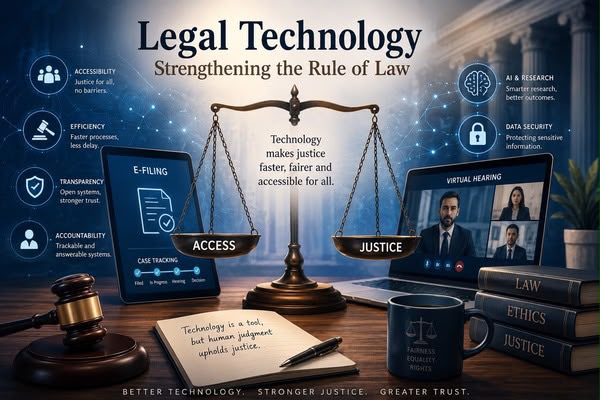
The rule of law is the foundation for communities of opportunity and equity — it is the predicate for eradicating poverty, violence, corruption, pandemics, and other threats to civil society. In the twenty-first century, legal technology has become an essential means of strengthening this foundation. As legal systems face increasing pressure from growing populations, complex disputes, and rising public expectations, technology offers practical solutions to improve the delivery of justice. LegalTech is no longer a luxury but a necessity for preserving the rule of law, making justice more accessible, transparent, efficient, and accountable.
One of LegalTech’s most important contributions is improving access to justice. Many individuals cannot afford legal representation or face geographical barriers that prevent them from seeking legal assistance. Digital legal platforms, virtual consultations, and AI-powered legal research tools have significantly reduced these barriers.
In the United Kingdom, for example, online civil claims and digital court services allow litigants to file claims and track proceedings without visiting a courthouse. Similarly, in the United States, platforms such as LegalZoom enable individuals and small businesses to prepare legal documents at affordable cost. These innovations show how technology can make legal services more inclusive, ensuring justice is available to all, not only to those who can afford expensive legal representation.
Legal technology also improves court efficiency. The legal maxim “justice delayed is justice denied” captures how delayed decisions weaken public confidence in the judiciary. Electronic filing systems, digital case management, and virtual hearings help reduce unnecessary delays and administrative burdens.
During the COVID-19 pandemic, courts in the United Kingdom, Singapore, and Canada successfully conducted remote hearings on secure digital platforms, ensuring judicial proceedings continued despite public health restrictions. These examples show that technology can maintain the continuity of justice while saving time and resources for judges, lawyers, and litigants alike.
Another major advantage of LegalTech is that it promotes transparency and accountability — fundamental principles of the rule of law. Digital records are less vulnerable to loss, alteration, or manipulation than paper files, while online case-tracking systems let litigants monitor their cases’ progress. Estonia, one of the world’s most digitally advanced countries, has integrated digital identity systems, electronic public services, and secure judicial databases that let citizens access legal services efficiently and transparently.
Similarly, Sweden has embraced digital governance to simplify administrative and legal procedures, reducing opportunities for corruption and increasing public trust in government institutions. These examples show that technology can strengthen public confidence in the justice system by making legal processes more open and accountable.
Artificial intelligence has become one of the most influential developments in LegalTech. AI-powered legal research tools such as Lexis+ AI, Westlaw Precision, and Harvey AI help lawyers analyze statutes, case law, and legal precedents within minutes, significantly improving productivity and accuracy. Large law firms in the United States and United Kingdom increasingly rely on AI to review contracts, identify legal risks, and assist with regulatory compliance.
AI should complement rather than replace judges and lawyers, however. Judicial decisions require ethical reasoning, human judgment, and consideration of social circumstances that technology alone cannot provide — so AI should remain a supportive tool, not the ultimate decision-maker.
Pakistan has also taken encouraging steps toward adopting LegalTech. During the COVID-19 pandemic, the Supreme Court of Pakistan and several High Courts introduced virtual hearings to keep judicial proceedings uninterrupted. The Lahore High Court implemented an e-filing system enabling lawyers to submit petitions electronically, reducing paperwork and administrative delays. The National Judicial (Policy Making) Committee (NJPMC) has further promoted the digitization of court records and case management systems to improve judicial efficiency and transparency.
Pakistan still faces challenges such as limited digital infrastructure, cybersecurity concerns, and unequal internet access, but these reforms show that LegalTech can strengthen the rule of law even in developing countries by making justice more accessible and efficient.
Despite its numerous benefits, LegalTech also presents real challenges. The digital divide may exclude people who lack internet access or technological literacy, particularly in rural areas. Cybersecurity and data privacy matter just as much, since courts and law firms manage highly confidential information. AI systems, moreover, may unintentionally produce biased outcomes if trained on incomplete or discriminatory data. Governments must therefore establish clear legal frameworks governing artificial intelligence, data protection, and cybersecurity, while ensuring continuous human oversight in judicial decision-making.
In short, LegalTech is indispensable for strengthening the rule of law in the modern world. It improves access to justice, enhances judicial efficiency, promotes transparency, and supports accountability within legal institutions. The experiences of developed countries such as the United Kingdom, Estonia, Sweden, Singapore, and the United States — together with Pakistan’s ongoing judicial reforms — demonstrate that technology can modernize legal systems without compromising the principles of justice.
Challenges such as digital inequality, cybersecurity, and ethical concerns must be addressed through appropriate regulation and investment, but they should not hinder technological progress. LegalTech represents necessary evolution, ensuring the rule of law remains effective, fair, and responsive to the needs of modern society.
The rule of law is the foundation for communities of opportunity and equity — it is the predicate for eradicating poverty, violence, corruption, pandemics, and other threats to civil society. In the twenty-first century, legal technology has become an essential means of strengthening this foundation.
As legal systems face increasing pressure from growing populations, complex disputes, and rising public expectations, technology offers practical solutions to improve the delivery of justice. LegalTech is no longer a luxury but a necessity for preserving the rule of law, making justice more accessible, transparent, efficient, and accountable.
One of LegalTech’s most important contributions is improving access to justice. Many individuals cannot afford legal representation or face geographical barriers that prevent them from seeking legal assistance. Digital legal platforms, virtual consultations, and AI-powered legal research tools have significantly reduced these barriers.
In the United Kingdom, for example, online civil claims and digital court services allow litigants to file claims and track proceedings without visiting a courthouse. Similarly, in the United States, platforms such as LegalZoom enable individuals and small businesses to prepare legal documents at affordable cost. These innovations show how technology can make legal services more inclusive, ensuring justice is available to all, not only to those who can afford expensive legal representation.
Legal technology also improves court efficiency. The legal maxim “justice delayed is justice denied” captures how delayed decisions weaken public confidence in the judiciary. Electronic filing systems, digital case management, and virtual hearings help reduce unnecessary delays and administrative burdens.
During the COVID-19 pandemic, courts in the United Kingdom, Singapore, and Canada successfully conducted remote hearings on secure digital platforms, ensuring judicial proceedings continued despite public health restrictions. These examples show that technology can maintain the continuity of justice while saving time and resources for judges, lawyers, and litigants alike.
Another major advantage of LegalTech is that it promotes transparency and accountability — fundamental principles of the rule of law. Digital records are less vulnerable to loss, alteration, or manipulation than paper files, while online case-tracking systems let litigants monitor their cases’ progress. Estonia, one of the world’s most digitally advanced countries, has integrated digital identity systems, electronic public services, and secure judicial databases that let citizens access legal services efficiently and transparently.
Similarly, Sweden has embraced digital governance to simplify administrative and legal procedures, reducing opportunities for corruption and increasing public trust in government institutions. These examples show that technology can strengthen public confidence in the justice system by making legal processes more open and accountable.
Artificial intelligence has become one of the most influential developments in LegalTech. AI-powered legal research tools such as Lexis+ AI, Westlaw Precision, and Harvey AI help lawyers analyze statutes, case law, and legal precedents within minutes, significantly improving productivity and accuracy. Large law firms in the United States and United Kingdom increasingly rely on AI to review contracts, identify legal risks, and assist with regulatory compliance.
AI should complement rather than replace judges and lawyers, however. Judicial decisions require ethical reasoning, human judgment, and consideration of social circumstances that technology alone cannot provide — so AI should remain a supportive tool, not the ultimate decision-maker.
Pakistan has also taken encouraging steps toward adopting LegalTech. During the COVID-19 pandemic, the Supreme Court of Pakistan and several High Courts introduced virtual hearings to keep judicial proceedings uninterrupted. The Lahore High Court implemented an e-filing system enabling lawyers to submit petitions electronically, reducing paperwork and administrative delays. The National Judicial (Policy Making) Committee (NJPMC) has further promoted the digitization of court records and case management systems to improve judicial efficiency and transparency.
Pakistan still faces challenges such as limited digital infrastructure, cybersecurity concerns, and unequal internet access, but these reforms show that LegalTech can strengthen the rule of law even in developing countries by making justice more accessible and efficient.
Despite its numerous benefits, LegalTech also presents real challenges. The digital divide may exclude people who lack internet access or technological literacy, particularly in rural areas. Cybersecurity and data privacy matter just as much, since courts and law firms manage highly confidential information. AI systems, moreover, may unintentionally produce biased outcomes if trained on incomplete or discriminatory data. Governments must therefore establish clear legal frameworks governing artificial intelligence, data protection, and cybersecurity, while ensuring continuous human oversight in judicial decision-making.
In short, LegalTech is indispensable for strengthening the rule of law in the modern world. It improves access to justice, enhances judicial efficiency, promotes transparency, and supports accountability within legal institutions. The experiences of developed countries such as the United Kingdom, Estonia, Sweden, Singapore, and the United States — together with Pakistan’s ongoing judicial reforms — demonstrate that technology can modernize legal systems without compromising the principles of justice.
Challenges such as digital inequality, cybersecurity, and ethical concerns must be addressed through appropriate regulation and investment, but they should not hinder technological progress. LegalTech represents necessary evolution, ensuring the rule of law remains effective, fair, and responsive to the needs of modern society.