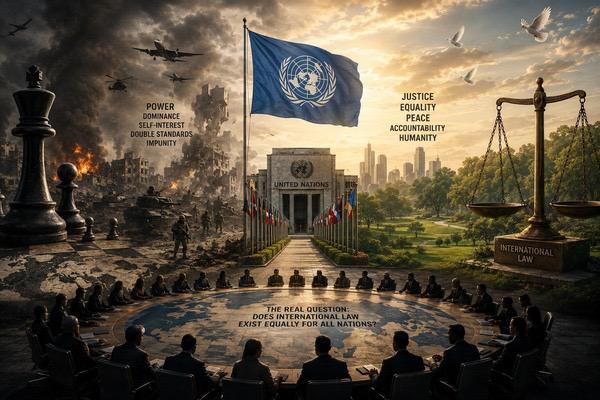
The dust of the Second World War had barely settled when the world witnessed the birth of another guarantor of peace and security, a modified and more ambitious institution after the failure of the League of Nations, this time under the title of the United Nations.
The principal proponents of the idea were the then United States President Franklin D. Roosevelt and the then British Prime Minister Winston Churchill. In 1945, representatives from fifty countries met at the San Francisco Conference, drafted the United Nations Charter, and signed it. Consequently, on October 24, 1945, the United Nations officially came into existence.
Since then, the world has witnessed wars, border clashes, massacres, genocides, and frequent exchanges of provocative rhetoric among nations, many of them signatories to the UN Charter itself. The Indo-Pak wars of 1947, 1965, and 1971, the Arab-Israeli War of 1948, the Vietnam War, the Iran-Iraq War, the Russia-Ukraine War, and the recent confrontation involving the United States, Israel, and Iran all create the impression that the United Nations may have been successfully established on paper, while its practical ability to prevent conflict has remained open to question.
Viewed through a realist lens, these wars were not anomalies but largely inevitable. International law does not operate primarily on morality or the often-celebrated principle of shared responsibility for maintaining peace. Rather, it functions within a power-centric international order rooted in the realities of human nature. To understand this, consider the analogy of a lion. In the jungle, a lion hunts a deer because it is the weaker creature. No matter how much meat is placed before it, the lion remains driven to pursue prey. This instinct cannot reasonably be condemned because it reflects the lion’s nature.
Likewise, states are naturally inclined to pursue advantage where they can. The jungle and the international system differ only in their actors. One is inhabited by animals, the other by states, yet both remain structured by competition and survival.
Even centuries before the creation of the United Nations, history was marked by wars in which stronger powers prevailed over weaker ones. Whether one looks at the expansion of the Roman Empire, the campaigns of Napoleon, or numerous imperial conquests across different civilizations, the historical pattern is remarkably consistent. Power has repeatedly determined outcomes more often than moral principles.
Nonetheless, critics may argue that the United Nations has prevented a third world war and therefore cannot fairly be described as a failure. There is some force in that argument. Institutions such as the International Court of Justice, UN peacekeeping missions, and humanitarian agencies have undoubtedly contributed to conflict management and diplomacy. Yet realism asks a different question, not whether such institutions exist, but whether they can enforce international law equally against powerful and weaker states alike.
The imbalance becomes difficult to ignore when weaker states are swiftly condemned, sanctioned, or isolated for violating international law, while powerful states often avoid comparable consequences because of their military strength, economic influence, or strategic alliances. Iran’s nuclear program and Russia’s invasion of Ukraine generated coordinated international pressure and sanctions.
By contrast, the United States’ invasion of Iraq in 2003, undertaken without explicit authorization from the UN Security Council and later justified by intelligence shown to be false, resulted in no equivalent institutional response. This selective application of international law remains one of the greatest contradictions within the contemporary international order.
The Security Council’s veto power further reinforces this imbalance by granting certain states privileges that stand above the very principles of sovereign equality upon which the United Nations claims to rest. The real question, therefore, is not whether international law exists, but whether it exists equally for all nations.
What, then, should the world do? Should every country respond by expanding its military capabilities without restraint? Should weapons of mass destruction be accepted as the logical outcome of self-preservation? The answer ultimately depends on what kind of international order humanity wishes to build. If the world accepts the law of the jungle, then the relentless pursuit of military superiority appears almost unavoidable. If, however, humanity chooses a path founded on cooperation, justice, and collective security, then it must move beyond declarations of principle and develop international institutions capable of enforcing those principles impartially.
To achieve that goal, every state, regardless of its economic or military strength, would need to surrender certain powers, particularly offensive military capabilities, to a genuinely impartial international institution in exchange for guaranteed security. This idea closely resembles Rousseau’s social contract, under which individuals surrender certain freedoms in return for peace and protection under a common authority.
The international system requires not an entirely new theory but an expansion of that principle, an “international contract theory.” Such an institution would differ fundamentally from the present United Nations because no state would enjoy permanent privileges such as the veto. Admittedly, this remains an idealistic and even utopian proposal. Yet if humanity genuinely seeks a more just international order, it represents a direction worth considering. If powerful states remain unwilling to surrender even a fraction of their strategic advantages, however, such a framework is unlikely ever to move beyond theory.
To conclude, the contemporary international order continues to reflect the realities of power politics more than the promises of universal justice. Institutions such as the United Nations have too often struggled to apply international law equally to powerful and weaker states alike, leaving their impartiality open to legitimate criticism. If the collective objective of humanity is a more peaceful and just world, then Rousseau’s philosophy offers a compelling foundation for rethinking international governance. If not, the international community should expect the global arms race to continue, along with the ever-present risk that unchecked competition may one day produce consequences far more devastating than that humanity has already endured.