Somewhere in Pakistan right now, a woman is turning down a marriage proposal. Not because the man lacks education, character, or financial stability, but because he belongs to the wrong biradari. Her family will keep searching, and she will keep waiting. This is not an unusual story, for millions of Pakistanis, it is simply how marriage works.
According to Gallup Pakistan survey data from June and July 2024, 81 percent of Pakistani marriages are arranged, while only 18 percent are love marriages. Family involvement clearly remains central to marriage here. But these numbers also raise a harder question: how much influence should caste and biradari continue to have over one of the most personal decisions a person can make?
For generations, marriage in Pakistan has been understood as a union of families, not just individuals. Within that tradition, caste and biradari have served as markers of trust and shared identity, and many parents genuinely believe that marrying within one’s own community improves the odds of a stable marriage. Some argue, sincerely, that this protects daughters, that shared backgrounds reduce friction and provide a built-in support network. That argument deserves to be taken seriously. But it rests on an assumption worth questioning that compatibility cannot exist outside caste boundaries.
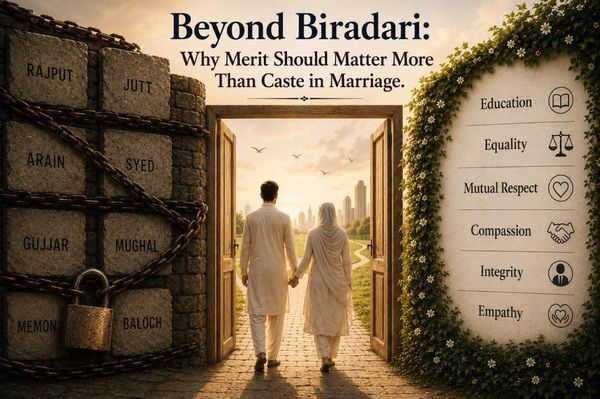
There is a real difference between a preference and a barrier. Across Pakistan, proposals are routinely judged less by character or compatibility than by inherited identity. A doctor, engineer, or teacher can be rejected for nothing more than belonging to the wrong caste — personal achievement made secondary to birth.
The scale of this isn’t anecdotal: a 2024 study using the Punjab Consanguinity Survey found that close to half of husbands surveyed said their families had restricted them to marrying within a specific caste or clan. This isn’t a fading custom practiced by a stubborn minority, for roughly half the families studied, it is simply the rule.
The same society that demands merit in classrooms and workplaces quietly sets that standard aside when it comes to choosing a life partner. This contradiction deserves more scrutiny than it gets. Parents pour resources into their children’s education and celebrate careers built on talent. Yet when marriage comes up, those same achievements can suddenly count for less than family lineage. A society that rewards excellence everywhere except in the choice of a spouse is sending itself a confusing message about what it actually values.
The cost of this isn’t shared equally. In communities where endogamy is the expectation, women bear the brunt of it, their pool of acceptable partners shrinks, and when no suitable match appears within those boundaries, many spend years waiting or feel pressed into marriages that are less compatible than they deserve.
This isn’t only a cultural cost. It’s a personal one, paid disproportionately by women, who have less room to wait out a shrinking pool or to push back against family timelines than men typically do.
Religion adds another layer worth considering. Pakistan is an overwhelmingly Muslim society, and a well-known prophetic tradition urges families to prioritize a prospective spouse’s faith and character, warning that ignoring these qualities invites discord. Lineage doesn’t appear in that guidance at all. If a cultural practice claims religious legitimacy while quietly ranking caste above character, it’s fair to ask whether the two actually line up.
Change, meanwhile, is already underway. Universities and workplaces bring people from different communities together every day. Matrimonial platforms increasingly let families filter by education and profession rather than lineage alone. Many families are, quietly and without announcement, starting to weigh character more heavily than caste. These shifts rarely make headlines, but they’re real.
None of this means biradari must disappear, or that change should be forced. Traditions evolve at their own pace, and social trust isn’t rebuilt overnight. The real question is simpler: should inherited identity continue to outweigh merit when it comes to choosing a life partner?
Tradition deserves respect, but respect shouldn’t put it beyond question. Customs that strengthen families are worth keeping. Customs that ask individuals, particularly women, to sacrifice opportunity over an accident of birth are worth re-examining.
Pakistan has long celebrated merit in education, employment, and public life. Whether it’s ready to apply that same standard to marriage is an open question and a society that measures people by merit in every room except the most intimate one hasn’t yet finished the argument it started.