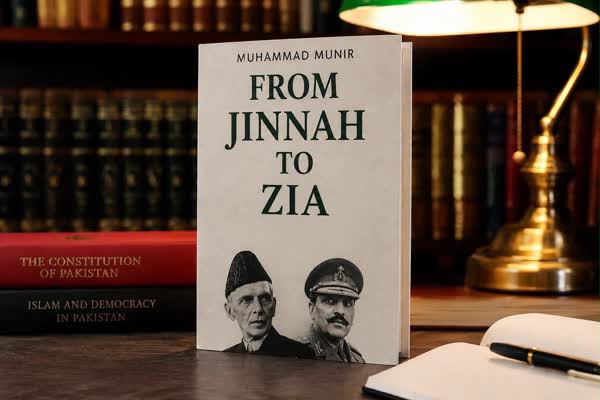
In 1954, a panel of religious scholars sat before a judicial inquiry in Lahore and tried to answer a simple question: who counts as a Muslim? They could not agree. The judge who chaired that inquiry, Muhammad Munir, wrote down the result in his official report and never let it go. Twenty-five years later, in the last year of his life, he built an entire book around that one finding: “no two learned divines are agreed on this fundamental.”
That book is From Jinnah to Zia, and the line above is its real subject.
Munir was not an outside critic. As Chief Justice of the Lahore High Court, he led the 1954 inquiry into the anti-Ahmadi riots of 1953, the report still known today as “the Munir Report.” Writing in 1979, with General Zia-ul-Haq’s Islamization drive in full swing, he set out to tell one story: how the secular state Jinnah described to the Constituent Assembly in August 1947 had, within a generation, fallen into the hands of the very forces Jinnah’s party had defeated at the ballot box.
The book itself is short, barely over a hundred pages, and can be read in one or two sittings. But absorbing what it argues takes much longer. Munir condenses twenty-five years of constitutional and religious debate into this slim volume, and some of his claims deserve weeks of reflection rather than a single evening’s read.
His argument is simple. Jinnah promised a state where religion was a private matter. Liaquat Ali Khan’s Objectives Resolution of 1949 broke that promise by placing sovereignty in the hands of God rather than the people, passed while non-Muslim members of the Assembly walked out in protest. Everything that followed, in Munir’s telling, runs back to that one shift: the 1953 riots, the 1974 law declaring Ahmadis non-Muslim, and Zia’s harsh new punishments, which Munir, himself a serious if unconventional reader of the Quran, insists were wrong even by the Quran’s own terms.
The best chapter is the one where he returns to his own inquiry. Among those who testified was Maulana Abul Ala Maududi, founder of the Jamaat-i-Islami, and Munir shows that by the logic of his own witnesses — Maududi included — Sunnis, Shias, Deobandis, Barelvis, and Ahl-i-Hadith could each have called the others apostates deserving death. He lets that absurdity make his case for him. For anyone trying to understand how Ahmadis came to be excluded in Pakistan, this chapter is close to a primary source, the man who ran the original inquiry, telling it again two decades later, now writing with the belief that the events of 1974 had vindicated his earlier concerns.
The book has real flaws. Much of it reads like a diary of current events rather than an argument, the siege of the Kaaba, the burning of the American embassy, the Soviet invasion of Afghanistan all wanders into chapters meant to be about constitutional history. Munir also drifts into personal memory, some of it vivid, most of it loosely tied to his main point. And his account of Partition-era politics is openly one-sided; his dislike of the religious parties who opposed Jinnah leaves little room for their side of the story. In places this reads less like history and more like a man defending himself, which, in part, it is.
A deeper irony the book never confronts belongs to its author. The same Munir defending Jinnah’s constitutionalism had earlier supplied the legal foundation for extra-constitutional rule. His court upheld the 1954 dissolution of the Constituent Assembly; in 1958 he formulated the “doctrine of necessity” to validate Ayub Khan’s coup. That doctrine later legitimized the very martial law regimes, including Zia’s, that Munir condemns in these pages.
I approached this book already knowing how the story ends: the 1974 amendment and the decades of exclusion that followed. What I had not expected was to hear the case argued by the very judge who had helped shape the legal history he was now trying to undo. That is why the book is still worth reading. It is less a history than a piece of testimony, written by someone who was in the room when Pakistan’s relationship with religion was being decided. Read it not for balance but for what only Munir could give: the verdict of the one judge who asked the question, and and watched no two scholars give him the same answer.